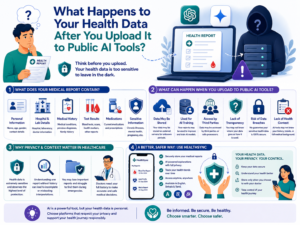

What Happens to Your Health Data After You Upload It to Public AI Tools?
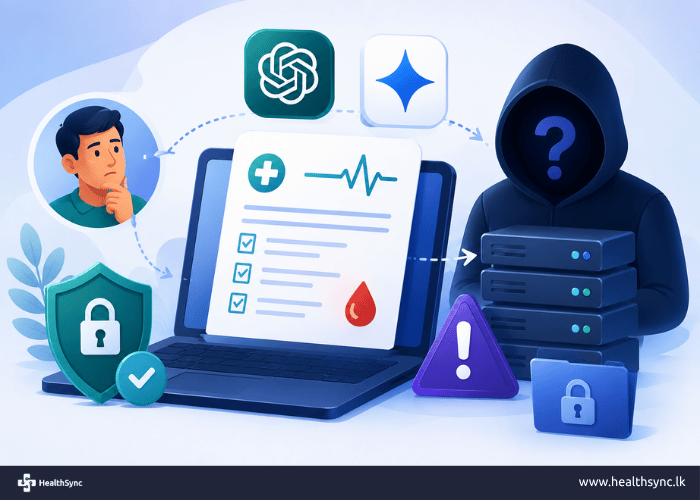
More people are now using AI tools like ChatGPT and Gemini to understand their medical reports.
A blood test arrives.
Someone takes a screenshot.
Uploads it into an AI chatbot.
And asks:
“Can you explain this?”
“Is this dangerous?”
“Do I have diabetes?”
“Should I be worried?”
It feels fast. Convenient.
And surprisingly helpful.
But there’s an important question many people never stop to ask:
What actually happens to your health data after you upload it to a public AI tool?
Your Medical Reports Contain More Information Than You Think
A medical report is not just a simple document.
It often contains:
- your full name
- age
- hospital or laboratory details
- doctor names
- medical conditions
- prescription information
- blood test results
- chronic disease indicators
In many cases, these reports reveal deeply personal information about your health and medical history.
That makes healthcare data very different from normal internet searches or casual conversations with AI.
Most People Upload Reports Without Thinking About Privacy
When people use public AI tools, they are usually focused on getting quick answers.
Few users stop to think about:
- where their uploaded files go
- how long the information is stored
- whether the data is retained
- who may access it
- whether the information could be used in future AI training systems
This does not necessarily mean public AI tools are unsafe.
But it does mean users should understand that healthcare data deserves a much higher level of privacy awareness.
What Can Actually Happen After You Upload a Medical Report to a Public AI Tool?
The answer depends on:
- the platform you use
- your privacy settings
- whether chat history is enabled
- how the AI provider handles uploaded content
In many public AI systems, uploaded conversations and files may be:
- temporarily stored on servers
- reviewed for safety and quality purposes
- retained for a period of time
- used to improve AI systems and future model training (depending on settings and platform policies)
Most users never read the privacy policies or data-handling settings before uploading sensitive medical documents.
This does not automatically mean your data is being publicly exposed or misused.
But it does mean many people are sharing highly personal health information into systems they do not fully understand.
Another important issue is permanence.
Once a medical report is uploaded into multiple tools, chats, screenshots, or apps, users often lose track of:
- where the report exists
- who has access
- whether copies remain stored elsewhere
- how long the information is retained
Healthcare data is different from asking AI to summarize an email or write social media captions.
Medical reports may contain lifelong health information, chronic disease indicators, prescription history, and sensitive personal details that deserve stronger protection and long-term control.
Healthcare Data Is Extremely Sensitive
Unlike many other types of information, health data can reveal:
- chronic illnesses
- mental health conditions
- pregnancy information
- medication usage
- hereditary conditions
- long-term disease risks
Once uploaded online, users often lose visibility into how that information may be handled across systems.
That’s why many healthcare organizations around the world operate under strict privacy regulations and compliance standards when handling patient records.
Another Problem: Lack of Health Context
Privacy is only one side of the issue.
The second challenge is context.
Generic AI tools usually analyze only the single report uploaded at that moment.
They often do not know:
- your previous reports
- your long-term health trends
- medications you take
- family history
- chronic conditions
- previous diagnoses
For example, an HbA1c value may look concerning on its own.
But a doctor may interpret it differently if:
- the value improved significantly compared to previous months
- the patient recently changed medication
- the patient already has diagnosed diabetes
Healthcare interpretation depends heavily on continuity and history.
Without that context, AI explanations may become incomplete or misleading.
AI Can Be Helpful – But Healthcare Requires More Responsibility
AI is incredibly powerful for simplifying medical information.
It can help users:
- understand reports faster
- recognize abnormal values
- learn medical terminology
- become more proactive about health
But healthcare should not be treated like a normal internet conversation.
Health information requires:
- stronger privacy protections
- secure storage
- long-term tracking
- responsible handling
- better continuity of care
A More Secure and Health-Focused Approach
HealthSync’s AI Report Interpreter is designed specifically for healthcare-focused report understanding and secure medical record organization.
Instead of uploading reports into disconnected public chats, users can:
- securely store medical reports
- organize records in one place
- access AI-powered explanations
- track changes over time
- review reports later when needed
- receive explanations in English, Sinhala, or Tamil
This creates a more structured and privacy-aware healthcare experience.
Your Health Data Should Not Be Disposable
One of the biggest problems today is that medical information becomes scattered everywhere.
Reports end up:
- in WhatsApp chats
- email inboxes
- screenshots
- random folders
- temporary AI conversations
Then during emergencies or future doctor visits, people struggle to find important information again.
Healthcare works better when records remain:
- organized
- accessible
- secure
- connected over time
The Future of AI in Healthcare Must Be Privacy-Conscious
AI will absolutely become part of the future of healthcare.
But as adoption grows, people will increasingly care about:
- privacy
- trust
- medical accuracy
- continuity
- secure data management
The goal should not simply be:
“Use AI faster.”
The goal should be:
“Use AI responsibly for healthcare.”
Because your medical history is not just another internet prompt.
It’s one of the most personal forms of data you own.