

Improving Patient Safety Through Digital Health Records – Insights from Prof. Kavinda Dayasiri
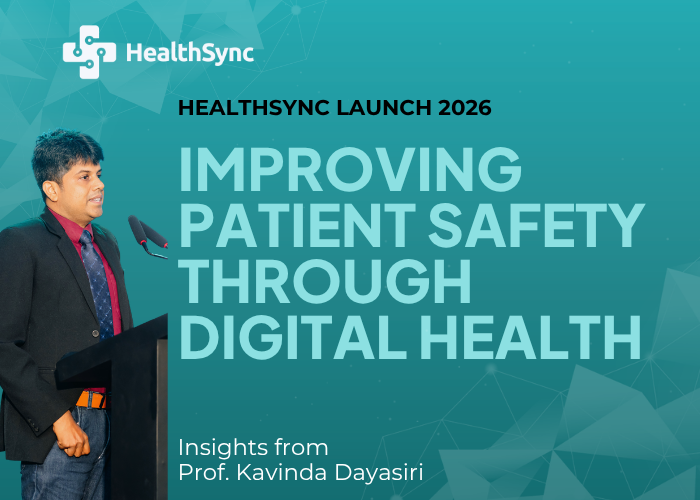
At the official launch of HealthSync, we were honored to welcome Prof. Kavinda Dayasiri as our Chief Guest.
During his speech, Professor Dayasiri highlighted the growing importance of electronic health records in improving patient safety, healthcare quality, and continuity of care in Sri Lanka.
One of the key points he shared was based on a recently published medical study that evaluated prescription practices across several provinces in Sri Lanka. According to the findings, electronically generated prescriptions showed significantly better quality, improved completeness, and fewer medication-related errors compared to handwritten prescriptions.
He explained that digital healthcare systems encourage more accurate documentation and reduce the likelihood of mistakes that can directly impact patient safety.
Professor Dayasiri also shared real-world examples from his work in pediatric healthcare and poison management services, where incorrect dosages, unclear prescriptions, and missing patient information can sometimes lead to serious medical complications.
Another important challenge he highlighted was the difficulty families face in managing long-term medical records. From misplaced files to damaged medical books, many patients struggle to maintain a complete health history over time – especially during transitions between healthcare providers.
Digital health platforms help address this by ensuring records remain securely stored, organized, and accessible whenever needed.
He also emphasized that for healthcare technology to create meaningful impact in Sri Lanka, it must remain:
- User-friendly
- Accessible
- Affordable
We are truly grateful to Prof. Kavinda Dayasiri for his support, encouragement, and valuable insights shared during this important milestone for HealthSync.
As Sri Lanka moves toward a more connected healthcare future, conversations like these play an important role in shaping safer, patient-centric digital healthcare systems for the country.