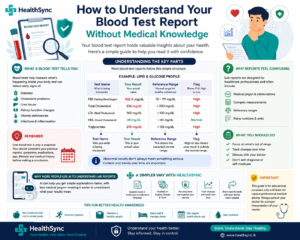

How to Understand Your Blood Test Report Without Medical Knowledge

You finally receive your blood test report.
You open the PDF… and immediately feel overwhelmed.
There are numbers everywhere.
Medical abbreviations.
Ranges.
Flags.
Terms you’ve never heard before.
FBS. LDL. HDL. HbA1c. Creatinine. Triglycerides.
And naturally, the first question that comes to mind is:
“Is something wrong with me?”
For many people, understanding a blood test report without medical knowledge can feel almost impossible. That’s why so many turn to Google, YouTube, or AI tools to try to make sense of their results.
The good news is: you do not need to be a doctor to understand the basics of your lab report.
What a Blood Test Report Actually Tells You
A blood test helps measure what is happening inside your body.
It can provide early signs of:
- diabetes
- cholesterol problems
- liver issues
- kidney function changes
- vitamin deficiencies
- infections
- inflammation
In many cases, blood tests can detect health concerns before symptoms even appear.
That’s why regular testing is important — especially for chronic conditions like diabetes and high cholesterol, which are increasingly common in Sri Lanka.
Why Blood Test Reports Feel Confusing
Most laboratory reports are designed for healthcare professionals.
They are often filled with:
- technical medical language
- abbreviations
- reference ranges
- complex measurements
For example, you may see something like:
Fasting Plasma Glucose (FBS): 102.4 mg/dL
But unless you understand what “normal range” means, the number alone does not help much.
This confusion leads many people to:
- panic unnecessarily
- ignore abnormal results
- misunderstand their condition
- rely on random internet advice
Understanding the Most Common Parts of a Lab Report
While every report is different, most blood test reports contain a few common sections.
Test Name
This tells you what is being measured.
Examples:
- FBS → blood sugar
- LDL → bad cholesterol
- HDL → good cholesterol
- Creatinine → kidney function
Your Result
This is your actual value.
Example: 102.4 mg/dL
Reference Range
This shows the normal range expected for healthy individuals.
Example: Normal: 70–99 mg/dL
If your number is above or below the range, it may be flagged as high or low.
But an abnormal result does not always mean something dangerous. Context matters.
One Blood Test Alone Does Not Tell the Full Story
This is one of the most important things people misunderstand.
A single blood test is only one snapshot in time.
Doctors usually consider:
- previous reports
- symptoms
- medications
- age
- lifestyle
- family history
- existing medical conditions
For example, a slightly elevated blood sugar result may indicate prediabetes in one person, while in another case it may simply require monitoring and lifestyle adjustments.
That’s why interpreting reports without proper context can sometimes be misleading.
Why More People Are Using AI to Understand Lab Reports
Today, many people upload blood reports into AI tools to get faster explanations.
And honestly, this behavior makes sense.
People want:
- simple explanations
- faster understanding
- less medical jargon
- guidance before seeing a doctor
The challenge is that generic AI tools are not specifically built for personal healthcare.
They may not understand:
- your previous reports
- long-term trends
- medical history
- continuity of care
A Simpler Way to Understand Medical Reports
HealthSync’s AI Report Interpreter is designed to help people understand lab reports in a more patient-friendly way.
Instead of showing only medical numbers, the system explains:
- what the result means
- whether it may need attention
- why the value matters
- possible lifestyle considerations
- recommended next steps
The reports are also available in:
- English
- Sinhala
- Tamil
making healthcare information easier to understand for more Sri Lankans.
Users can securely save reports, compare changes over time, and keep everything organized in one place instead of losing files inside WhatsApp chats or email inboxes.
Understanding Your Health Shouldn’t Feel Intimidating
Healthcare becomes much less stressful when people clearly understand what is happening inside their own bodies.
You do not need to memorize medical textbooks.
But understanding the basics of your blood test report can help you:
- ask better questions
- recognize warning signs earlier
- track chronic conditions
- stay more involved in your own healthcare journey
And sometimes, that awareness alone can make a huge difference.
Looking for a simpler way to understand your blood test reports?
HealthSync’s AI-powered report interpreter helps explain complex medical reports in easy-to-understand language while securely organizing your health records for future reference.