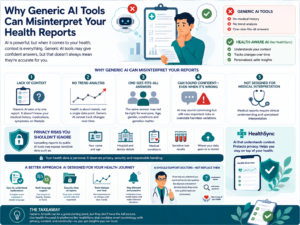

Why Generic AI Tools Can Misinterpret Your Health Reports
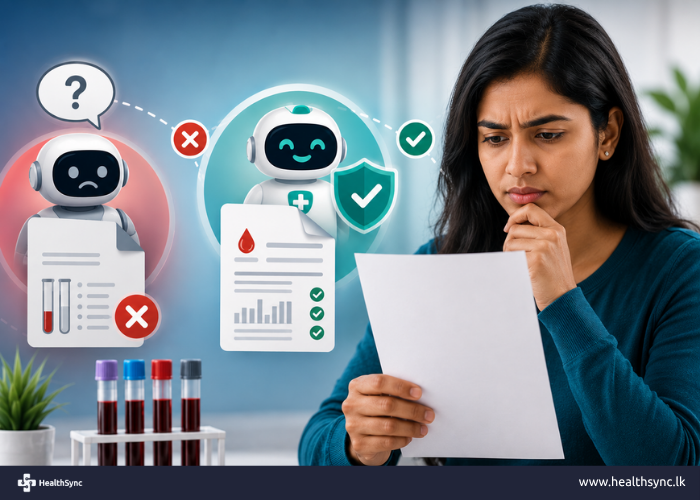
AI tools like ChatGPT and Gemini are changing the way people search for health information.
Today, many people simply upload a blood test report or type symptoms into an AI chatbot and ask:
“What does this mean?”
“Should I be worried?”
“Do I have diabetes?”
“Is my cholesterol dangerous?”
And honestly, this behavior is understandable.
Medical reports are often confusing, difficult to read, and full of technical terms most people are unfamiliar with.
AI can make health information feel more accessible.
But there’s an important problem many users don’t realize:
Generic AI tools are not specifically designed to understand your personal health history.
And because of that, they can sometimes misinterpret your health reports.
Your Health Report Is More Than Just Numbers
A lab report is not simply a collection of values.
Doctors interpret reports using context such as:
- previous test results
- chronic conditions
- medications
- family history
- age
- symptoms
- lifestyle habits
- medical history over time
For example, a slightly elevated fasting blood sugar level may mean different things depending on the individual.
In one person, it could suggest early prediabetes.
In another, it may simply require monitoring and lifestyle improvements.
Without proper medical context, even accurate-looking AI answers can become misleading.
Generic AI Does Not Know Your Health Journey
One of the biggest limitations of public AI tools is continuity.
Every time you upload a report into a generic chatbot, the system often sees only that single document.
It usually does not know:
- what your last report looked like
- whether your cholesterol improved
- if you already have diabetes
- what medications you take
- whether a result has been stable for years
Healthcare is not a one-time conversation.
It is a long-term journey built around patterns and trends.
That missing context is one reason generic AI tools can sometimes produce incomplete interpretations.
AI Can Sound Confident – Even When It’s Wrong
Another challenge is that AI-generated answers often sound very convincing.
This can create false reassurance or unnecessary panic.
For example:
- a harmless variation might sound alarming
- an important warning sign may be minimized
- lifestyle advice may be too generic
- recommendations may not fit the individual
This does not mean AI is bad.
It simply means healthcare requires a higher level of responsibility and context than many general-purpose AI systems were originally designed for.
Medical Reports Need Specialized Interpretation
Healthcare information is different from asking AI to:
- summarize an article
- write an email
- generate code
- answer trivia questions
Medical reports involve:
- sensitive health information
- potential diagnoses
- chronic disease monitoring
- risk assessment
- clinical interpretation
That’s why health-related AI tools should ideally be:
- privacy-focused
- medically structured
- context-aware
- designed specifically for healthcare workflows
Privacy Matters More Than Most People Realize
Many users also overlook the privacy side of uploading medical reports into public AI tools.
Lab reports may contain:
- your name
- age
- hospital details
- medical conditions
- doctor information
- sensitive test results
Healthcare data is deeply personal.
People deserve to know:
- where their information goes
- how it is stored
- whether it is retained
- how it may be used in the future
This is especially important as AI usage becomes more common in healthcare.
A Better Approach to AI Health Interpretation
AI can still play an incredibly valuable role in helping people understand their health reports.
The key difference is using tools designed specifically for healthcare interpretation and continuity.
HealthSync’s AI Report Interpreter helps users:
- understand medical reports in simple language
- receive explanations in English, Sinhala, or Tamil
- securely store reports for future reference
- track changes over time
- keep medical records organized in one place
Instead of only generating a quick answer, the goal is to help users better understand their health journey over time.
AI Should Support Doctors – Not Replace Them
One of the healthiest ways to think about AI in healthcare is this:
AI should improve understanding, not replace professional medical care.
A good AI health platform should help people:
- become more informed
- ask better questions
- recognize trends earlier
- stay engaged with their health
while still encouraging users to consult qualified healthcare professionals for diagnosis and treatment decisions.
The Future of AI in Healthcare
AI is becoming part of everyday healthcare faster than most people expected.
But not all AI tools are built the same.
As more people use AI to interpret blood test reports and medical records, trust, privacy, continuity, and medical context will become increasingly important.
Because healthcare is not just about getting an answer quickly.
It’s about understanding the full picture behind your health.