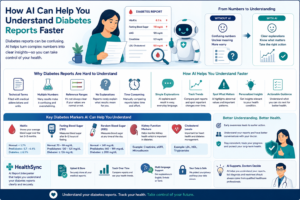

How AI Can Help You Understand Diabetes Reports Faster
Diabetes is one of the fastest-growing health concerns in Sri Lanka and around the world.
But for many people, the hardest part is not just managing the condition.
It’s understanding the reports.
Every few months, patients receive blood test results filled with terms like:
- HbA1c
- Fasting Blood Sugar (FBS)
- Random Blood Sugar (RBS)
- eAG
- Creatinine
- LDL cholesterol
And naturally, many people ask:
“Are my numbers improving?”
“Is this dangerous?”
“What does HbA1c actually mean?”
“Am I becoming diabetic?”
For someone without a medical background, diabetes reports can feel overwhelming.
That’s where AI is starting to make a real difference.
Why Diabetes Reports Are Difficult to Understand
Most laboratory reports are designed for healthcare professionals.
The reports usually show:
- technical abbreviations
- reference ranges
- medical units
- highlighted values
- multiple pages of numbers
But they rarely explain:
- what the results actually mean
- whether the condition is improving
- what changes may be needed
- what should be monitored next
As a result, many patients:
- ignore their reports
- panic unnecessarily
- depend entirely on internet searches
- misunderstand important warning signs
AI Makes Medical Information Easier to Understand
AI tools can help simplify complicated medical information into easier explanations.
Instead of only showing: HbA1c: 6.1%
AI can explain:
- what HbA1c measures
- whether the value falls within normal, prediabetic, or diabetic range
- why it matters
- what lifestyle changes may help improve it
This makes healthcare information more accessible for everyday users.
Understanding Diabetes Trends Is More Important Than One Number
One of the biggest mistakes people make is focusing only on a single blood test result.
Diabetes management is about trends over time.
For example:
- Is your HbA1c improving?
- Is your fasting sugar becoming stable?
- Are cholesterol levels getting worse?
- Are kidney function markers changing?
Doctors often look at long-term patterns rather than one isolated report.
This is where AI becomes especially useful.
AI can help users:
- compare past reports
- recognize trends
- identify gradual changes
- understand progress over time
instead of only reacting to one number on one day.
The Problem With Generic AI Tools
Today, many people upload diabetes reports into general AI tools like ChatGPT or Gemini.
While these tools may provide quick explanations, they often lack:
- your medical history
- previous reports
- medication information
- continuity over time
- personalized health context
This can sometimes lead to:
- incomplete explanations
- misleading interpretations
- generic recommendations
- unnecessary fear or false reassurance
Healthcare requires more context than a one-time conversation.
A Smarter Way to Understand Diabetes Reports
HealthSync’s AI Report Interpreter is designed specifically to help users understand medical reports in a more meaningful and organized way.
Instead of only generating generic responses, the platform helps users:
- understand blood sugar reports in simple language
- identify abnormal values more clearly
- securely store reports for future comparison
- track diabetes-related trends over time
- access explanations in English, Sinhala, or Tamil
For example, if a report shows: HbA1c: 6.1%
the system can explain that the value falls within the prediabetes range and help users understand why lifestyle changes are important before the condition progresses further.
AI Should Help People Become More Aware
AI is not meant to replace doctors.
But it can help people become more informed and proactive about their health.
Better understanding leads to:
- earlier action
- improved awareness
- more meaningful doctor conversations
- stronger long-term disease management
And for chronic conditions like diabetes, that awareness can make a huge difference over time.
The Future of Diabetes Monitoring
Healthcare is becoming increasingly digital.
In the future, many people will expect:
- easier explanations
- visual health trends
- smarter tracking
- multilingual health support
- secure medical record management
AI-powered tools can help bridge the gap between complex medical information and everyday understanding.
Because managing diabetes becomes much easier when people truly understand what their reports are telling them.